Personalisation in NovoNote allows you to tailor the AI to your professional context, therapeutic approach, and writing style. By customising key preferences—such as your clinical focus, treatment modalities, formatting guidelines, and tone—you can ensure that NovoNote produces documentation that is professionally appropriate and aligns with how you genuinely work.
Settings below help the AI provide personalised clinical notes, reports, and case formulations that reflect your unique practice style and preferred way of writing. Whether you prefer concise and structured documentation or a more narrative approach, NovoNote adapts to your needs.
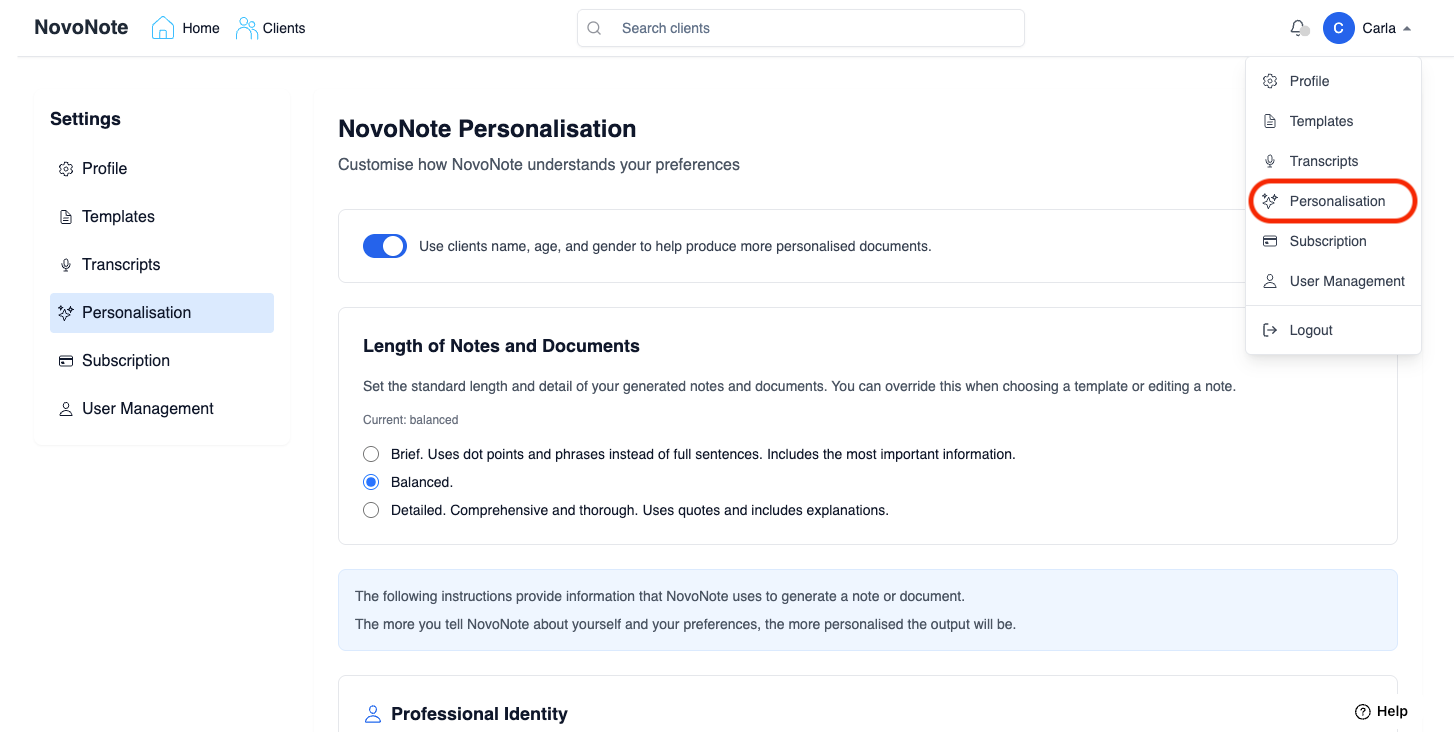
How to Set Up Personalisation
1. Choose Your Preferred Length of Notes and Documents
This setting determines the default length and level of detail of your notes and documents, ensuring you capture the right amount of information for every situation. You can select from three levels of detail:
- Brief: Uses dot points and phrases instead of full sentences.
- Balanced: Standard length and detail based on the chosen template.
- Detailed: Comprehensive and thorough.
This setting will apply to every note or document you produce; however, you can override this for any individual note or document.
To Learn More, See: Detail and Length of Notes and Documents - Settings. 2. Professional Identity: Defining Your Professional Identity
This section allows NovoNote to tailor its responses based on your professional background, areas of expertise, and clinical focus. By providing relevant details, NovoNote can generate more accurate, contextually appropriate, and personalised content for your needs.
For example, this might include:
- Your professional role (e.g., Clinical Psychologist, Social Worker, Mental Health OT)
- Your client population (e.g., children, adolescents, adults, neurodivergent individuals, trauma survivors)
- Your clinical focus (e.g., eating disorders, anxiety, mood disorders, psychosis, pain management)
- Your assessment experience (e.g., cognitive testing, ADHD/Autism assessments, personality assessments).
- Any relevant workplace context (e.g., working in a hospital setting vs. private practice).
Example:
“I am a clinical psychologist working in a multidisciplinary team at a public hospital, specialising in mood and anxiety disorders in adolescents and young adults. My role involves both individual therapy and conducting comprehensive cognitive and personality assessments. I also facilitate group therapy sessions for individuals with generalised anxiety disorder.”
3. Treatment Approaches: Specifying Your Treatment Modalities or Theoretical Orientations
By listing your therapeutic modalities, NovoNote can align formulations, progress notes, and treatment planning with your practice.
For example, this might include:
- Cognitive Behavioural Therapy (CBT) – including variations like CBT-E (for eating disorders) or TF-CBT (for trauma).
- Acceptance and Commitment Therapy (ACT) – incorporating psychological flexibility, values, and mindfulness-based techniques.
- Dialectical Behaviour Therapy (DBT) – structured around emotion regulation, distress tolerance, interpersonal effectiveness, and mindfulness.
- Psychodynamic Therapy – focusing on unconscious processes and relational patterns.
- Interpersonal Therapy (IPT) – targeting interpersonal difficulties and their impact on mood disorders.
- Schema Therapy – addressing maladaptive schemas developed in early life.
Example:
“I primarily use Cognitive Behavioural Therapy (CBT) and Acceptance and Commitment Therapy (ACT) in my practice. I integrate DBT skills when working with clients who struggle with emotion dysregulation and distress tolerance. My approach is evidence-based and goal-oriented, ensuring that treatment plans align with the client’s presenting concerns and therapeutic goals.”
4. Document Style: Customising Formatting and Writing Style
This section allows you to describe your preferred writing style, terminology, and formatting for clinical documentation. Some factors you may wish to consider include:
Writing Style & Readability:
- Use a narrative style that allows for readability rather than rigid bullet points or overly structured templates.
- Ensure cohesive and well-organised writing that is engaging but maintains clinical precision.
- Incorporate direct client quotes where relevant to capture key insights, thoughts, and emotional experiences.
- Maintain an objective and neutral tone, avoiding unnecessary embellishment or emotive phrasing.
Formatting & Structure:
- Use Australian English spelling and grammar.
- Ensure clear distinctions between observations, client self-reports, and clinical interpretation.
- Avoid assumptions—documentation should be evidence-based and justifiable.
Example:
“Ensure clinical documentation is structured, professional, and follows psychological standards. Use a clear narrative format with logical flow, incorporating direct client quotes when relevant. Maintain professional, neutral language, avoiding unnecessary jargon. Where applicable, follow structured frameworks (e.g., 5 P’s model) while keeping reports detailed yet readable, balancing clinical utility with accessibility.”
The more users tell NovoNote about themselves and their preferences, the more personalised the output will be. Benefits of Personalisation
- Improved Accuracy – Notes reflect your specific clinical language and approach.
- Consistency – Ensures uniformity in formatting and terminology across all notes.
- Efficiency – Reduces the need for manual edits and refinements in session notes.
To update your preferences at any time, visit the Personalisation settings in NovoNote.
Was this article helpful?
That’s Great!
Thank you for your feedback
Sorry! We couldn't be helpful
Thank you for your feedback
Feedback sent
We appreciate your effort and will try to fix the article